Ctrl+A to select everything, then Ctrl+C to copy, then paste into a new Substack post. Headings, the table, the hero image and links convert to native Substack blocks. (This yellow hint is outside the article — you can leave it selected; Substack drops it on paste.)
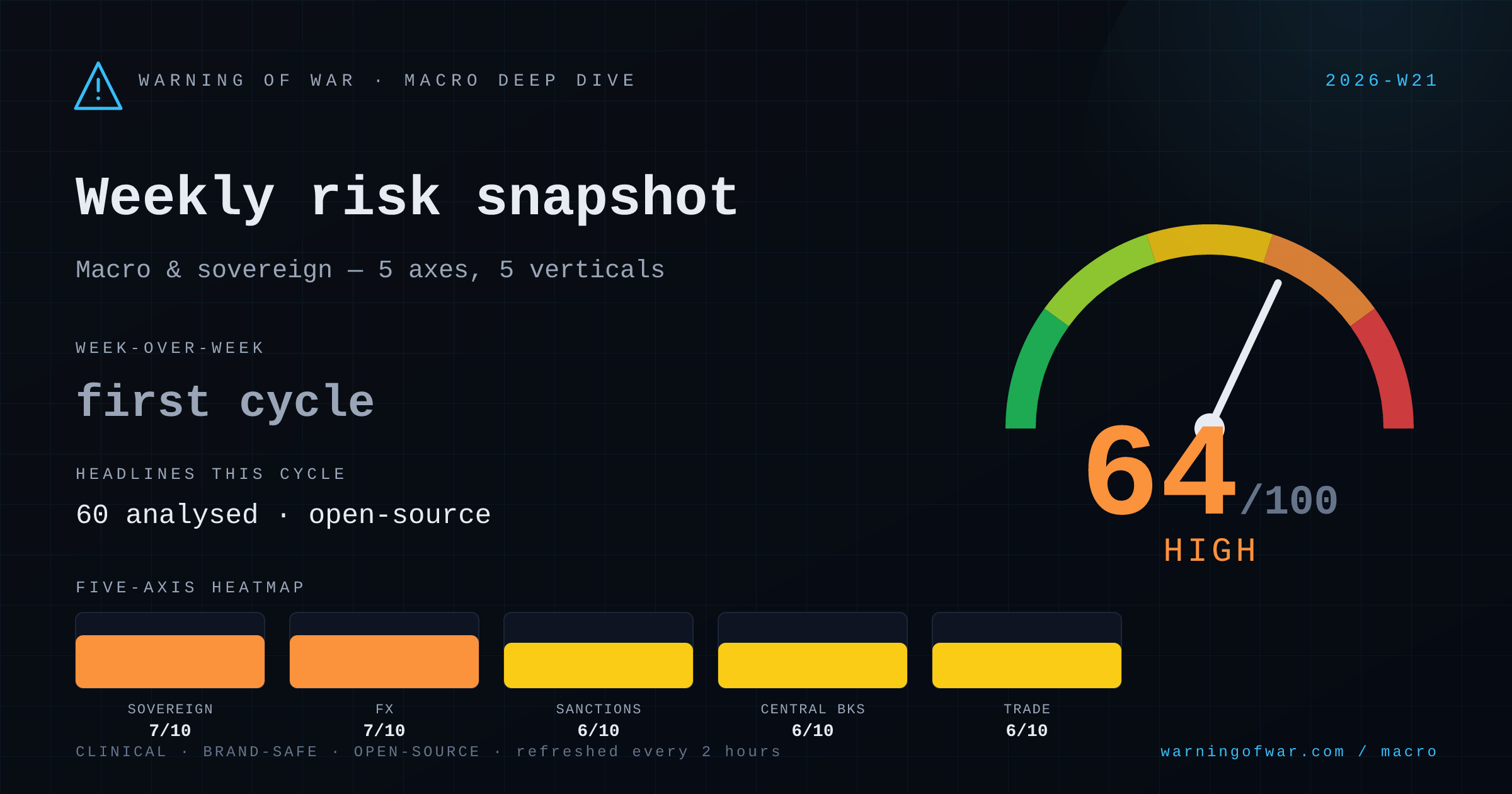
64/100 · High — first weekly snapshot.
Global macro risk is elevated across multiple axes this cycle. Moody's downgrade of the United States sovereign rating and its concurrent cut of Mexico to Baa3 (one notch above sub-investment grade) have widened sovereign-credit dispersion across the Americas. Fitch's negative outlook revision on a frontier sovereign — likely Bangladesh — and ongoing IMF programme engagement with Pakistan, Sri Lanka, Zimbabwe, and Ghana underscore persistent debt-sustainability pressures in frontier and emerging markets. The Reserve Bank of India has revived pre-market FX intervention to arrest rupee depreciation, while Indonesia's rupiah faces political opacity risk. The euro is under pressure following soft French PMI prints. OFAC sanctioned the Sinaloa Cartel's Ethereum-linked network, extending crypto-asset enforcement perimeter. A US–China tariff-reduction framework dialogue on $30 billion in trade and cautious US–Iran nuclear diplomatic signals are the two key tail-risk moderators. The Bank of Japan's rate trajectory and RBC BlueBay's expanded yen long position add further G10 central-bank policy complexity.
| Axis | Score | Band | WoW |
|---|---|---|---|
| Sovereign Credit & Default | 7/10 | High | · — |
| FX & Currency | 7/10 | High | · — |
| Sanctions & Capital Flows | 6/10 | Elevated | · — |
| Central Bank Policy | 6/10 | Elevated | · — |
| Trade & BoP | 6/10 | Elevated | · — |
(no prior week)
Moody's downgrade of the United States sovereign rating and a concurrent cut of Mexico to Baa3 (stable outlook) dominate the developed- and emerging-market credit agenda. Fitch's negative outlook on a frontier sovereign (widely attributed to Bangladesh) signals further potential deterioration absent fiscal consolidation. On the recovery side, S&P upgraded seven Nigerian banks following a sovereign rating uplift, Ghana completed its IMF programme earning German commendation, and Sri Lanka expects a $700 million IMF disbursement on 27 May. Pakistan's IMF mission concluded with commitment to a 2% primary surplus by FY27. Zimbabwe's programme is described as progressing strongly. The net picture is bifurcated: advanced-economy and upper-middle-income sovereign credit is under renewed pressure while select frontier markets execute programme exits.
Operational signals
Headlines this cycle
(no prior week)
The Reserve Bank of India (RBI) has revived pre-market FX intervention to arrest rupee depreciation, with Bloomberg reporting active consideration of rate-hike measures as a complementary tool. Indonesia's rupiah faces credibility risk after President Prabowo appeared to dispute official depreciation data. The Nigerian naira appreciated modestly after the CBN held its policy rate, but the naira-dollar rate remains closely watched given ongoing oil-subsidy reform. The euro extended losses following below-consensus French PMI readings. The dollar remained broadly firm but capped below a six-week peak as US–Iran diplomatic signals reduced safe-haven demand. RBC BlueBay expanded yen long positions citing BOJ rate expectations and intervention risk. South Africa is clarifying crypto-asset capital-control treatment, expanding the regulatory FX perimeter.
Operational signals
Headlines this cycle
(no prior week)
OFAC extended its enforcement perimeter into digital assets by designating Sinaloa Cartel-linked Ethereum addresses, reinforcing secondary-sanctions risk for DeFi and crypto custodians globally. An Indian corporate entity settled $275 million with OFAC over alleged Iranian sanctions violations, underscoring extraterritorial enforcement reach into South Asian supply chains. Ukraine's intelligence apparatus publicly documented active Russian evasion of EU restrictive measures via third-country intermediaries, sustaining secondary-sanctions risk for correspondents in CIS, Gulf, and South-East Asian jurisdictions. Separately, FT analysis highlights Iran's geopolitical displacement as a structural accelerant for Chinese renminbi adoption in sanctioned-economy bilateral trade — a long-duration capital-flow realignment signal.
Operational signals
Headlines this cycle
(no prior week)
The Reserve Bank of India is deploying pre-market FX intervention and evaluating a rate hike to stabilise the rupee — a dual-instrument response not seen since the 2013 taper tantrum episode, which Mint's editorial explicitly invokes as a cautionary parallel. Nigeria's Central Bank of Nigeria (CBN) held its policy rate, providing a stabilising naira signal. The Bank of Japan's rate trajectory is sufficiently clear for RBC BlueBay to materially extend yen long positions citing both BOJ hike expectations and intervention probability. The US bond market's constraint on fiscal policy — referenced in Reuters' 'Trump blinks' analysis — indirectly narrows Fed optionality. Australia's RBA faces reduced pressure to hike as unemployment rises to a 4.5-year high. Gold's steady posture amid Iran truce signals suggests lower near-term safe-haven-driven rate-hike expectations.
Operational signals
Headlines this cycle
(no prior week)
US–China negotiations on a tariff-reduction framework covering approximately $30 billion in trade flows constitute the most significant bilateral trade-policy development this cycle, potentially signalling a partial rollback of existing levies. China–Russia bilateral trade is documented as deepening across consumer and industrial goods categories, reinforcing a parallel trade architecture outside Western-led frameworks. Iran's nuclear threshold status and associated diplomatic activity — including Xi–Putin coordination in Beijing — create structural optionality for renminbi invoicing and yuan-denominated trade settlement as a sanctions-evasion mechanism. Pakistan's IMF-aligned fiscal programme includes trade-balance consolidation targets. The UK government announced targeted food-tariff cuts and social-transport measures, representing a minor domestic trade-policy signal.
Operational signals
Headlines this cycle
No named disruption events reported in this cycle.
Outlook pending next cycle.