Ctrl+A to select everything, then Ctrl+C to copy, then paste into a new Substack post. Headings, the table, the hero image and links convert to native Substack blocks. (This yellow hint is outside the article — you can leave it selected; Substack drops it on paste.)
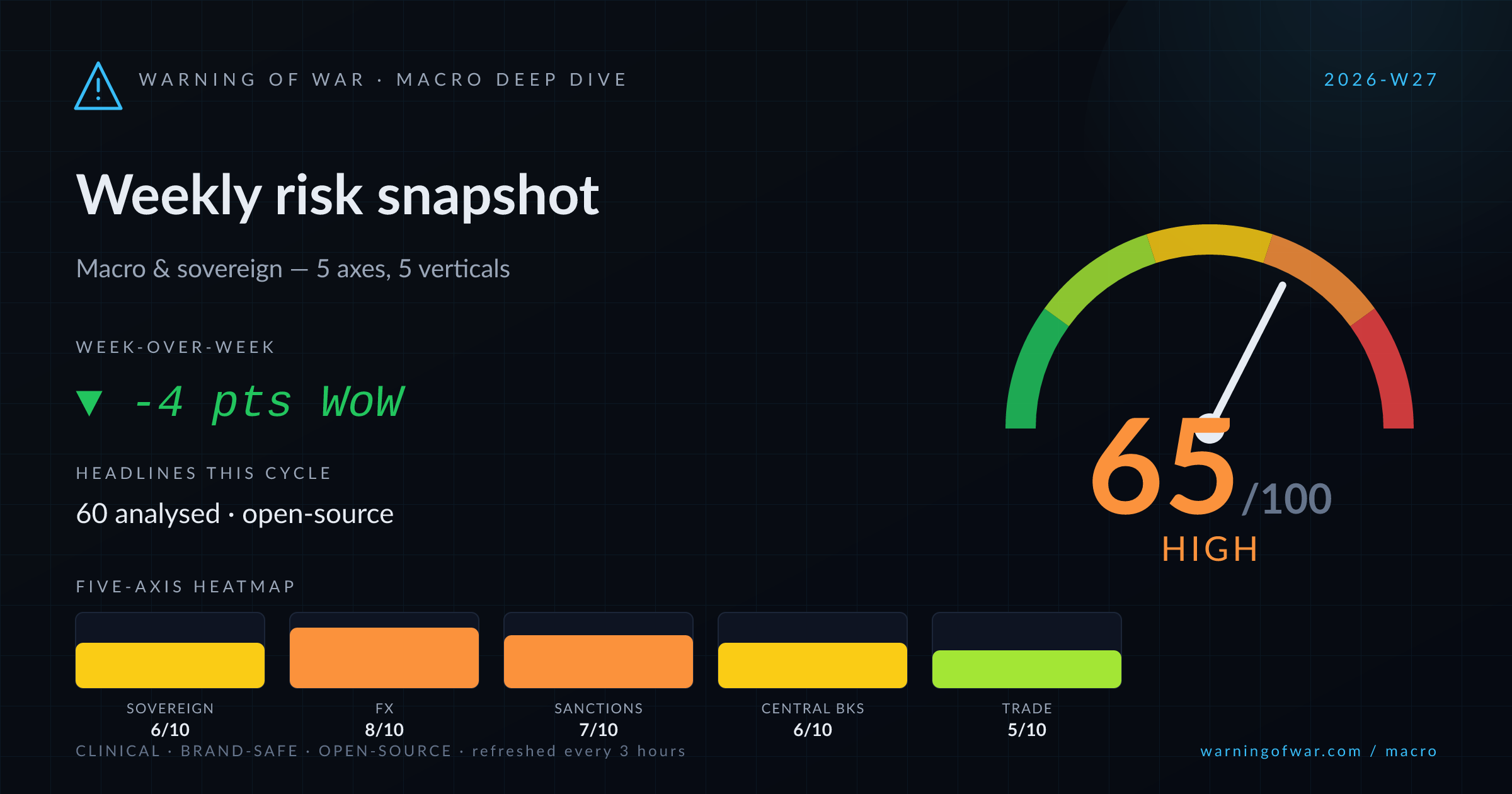
65/100 · High — -4 pts WoW.
This cycle's dominant signals are a JPY/USD dislocation to 40-year lows with market speculation targeting 200, a Korean won under pressure from foreign equity outflows despite a 30-month inflation high, and a fragile INR as RBI intervention thins. On sovereign credit, IMF programs for Sri Lanka and Ethiopia are advancing while Nigeria draws fresh World Bank facilities amid rising debt concerns. OFAC has extended its crypto-sanctions perimeter via 134 ISIS-K-linked wallet designations with Tether compliance. ECB policy council is fractured on the next rate move, while incoming Fed Chair Warsh signals balance-sheet tightening and de-emphasises forward guidance. BIS flags systemic AI-investment risk.
| Axis | Score | Band | WoW |
|---|---|---|---|
| Sovereign Credit & Default | 6/10 | Elevated | → no change |
| FX & Currency | 8/10 | High | ▲ +1 |
| Sanctions & Capital Flows | 7/10 | High | ▼ -1 |
| Central Bank Policy | 6/10 | Elevated | ▼ -1 |
| Trade & BoP | 5/10 | Guarded | ▼ -1 |
→ no change
Sri Lanka's IMF-supported stabilisation program is receiving a senior IMF endorsement alongside a fresh World Bank $150M disbursement, confirming the sovereign's continued dependence on multilateral credit. Nigeria has secured a combined $3B+ in new World Bank facilities amid documented debt concerns, signalling persistent fiscal fragility under the Tinubu reform agenda. Ethiopia's IMF program proceeds on-track with a $464M tranche approval. Morocco receives a $265M World Bank infrastructure loan. The BIS's financial-stability warning on AI-investment boom adds a systemic overlay relevant to sovereign risk pricing across G20 markets.
Operational signals
Headlines this cycle
▲ +1 WoW
The Japanese yen has depreciated to its weakest level against the USD in four decades, prompting active trader modelling of worst-case intervention scenarios and short-positioning for further declines toward 200. The Bank of Japan faces compounding pressure from U.S. monetary policy speculation. South Korea's won is simultaneously under pressure from foreign-investor equity liquidation, even as CPI accelerates to a 30-month high. India's rupee rebound is fading as RBI intervention thins and arbitrage flows re-emerge. Vietnam's State Bank is actively intervening to stabilise the dong against inflationary pressure. The firmer dollar is broadly suppressing base metals and commodity-linked EM currencies.
Operational signals
Headlines this cycle
▼ -1 WoW
The U.S. Treasury's OFAC designated 134 cryptocurrency wallets linked to an ISIS-K financing network, marking a significant escalation of digital-asset sanctions enforcement. Tether responded by freezing USDT holdings across 131 TRON wallets, with cumulative frozen balances reaching $4.4B — a record for a single enforcement action in the stablecoin sector. The action signals that OFAC is systematically extending secondary-sanctions risk into the decentralised-finance and stablecoin infrastructure. Separately, Lokesh Machines Limited secured India's first successful OFAC delisting, establishing a precedent for Indian corporates contesting SDN designations. Iran's oil sanctions environment remains effectively enforced as its floating stockpile swells with major buyers absent.
Operational signals
Headlines this cycle
▼ -1 WoW
At the ECB Sintra forum, incoming Fed Chair Warsh signalled a pivot in Fed communications strategy — downplaying forward guidance and flagging intentions to address the $7 trillion balance sheet — finding broad alignment with other G10 central bank governors. ECB governing council members are publicly divided on the next rate step as oil price declines pull inflation lower. The Bank of England is advancing a macro-prudential framework to constrain hedge-fund leverage. The Vietnam State Bank and the Reserve Bank of India are separately managing FX and inflation conditions through active market operations. South Korea's Bank of Korea faces hawkish pressure from the highest CPI reading in 30 months.
Operational signals
Headlines this cycle
▼ -1 WoW
South Korea's record trade surplus is providing insufficient offset to won depreciation driven by foreign-investor equity outflows, highlighting the decoupling between goods-trade performance and capital-account dynamics. Nigeria's federal government is implementing targeted tariff reductions to ease domestic consumer price pressure. Diplomatic friction between the U.S. and Saudi Arabia over Hormuz access threatens to introduce a geopolitical risk premium on energy trade flows through the Strait — a chokepoint relevant to Asian import-dependent economies. Base metals are retreating on Hormuz optimism and a stronger dollar. U.S.-Iran talks, brokered via Qatar, remain ongoing with no resolution to existing trade and sanctions frameworks.
Operational signals
Headlines this cycle
| Event | Vertical | Status | Description |
|---|---|---|---|
| JPY Currency Dislocation | fx-currency | ACTIVE | The Japanese yen has reached a 40-year low versus the U.S. dollar, with market participants actively modelling worst-case scenarios and short sellers increasing directional bets, raising the probability of Bank of Japan or Ministry of Finance FX intervention. |
| OFAC ISIS-K Crypto Sanctions Action | sanctions-capital-flows | ACTIVE | U.S. Treasury OFAC has designated 134 cryptocurrency wallets linked to an ISIS-K financing network, with Tether executing compliance freezes on 131 TRON wallets representing $4.4B in USDT — a record digital-asset sanctions enforcement action. |
| ECB Policy Council Fracture | central-banks-policy | RISING | ECB governing council members are publicly diverging on the direction of the next rate move as oil-price-driven disinflation erodes the hawkish case, introducing forward-guidance uncertainty into Eurozone sovereign spread pricing. |
| Korean Won & CPI Divergence | fx-currency | ACTIVE | South Korea's Korean won is declining against the U.S. dollar on sustained foreign-investor equity outflows even as domestic CPI accelerates to a 30-month high, creating a policy dilemma for the Bank of Korea between currency defence and rate normalisation. |
| Nigeria Sovereign Debt Accumulation | sovereign-credit | RISING | Nigeria has drawn over $3B in new World Bank facilities this cycle, with press commentary flagging rising debt-sustainability concerns against a backdrop of ongoing fiscal reforms under the Tinubu administration. |
| U.S.-Saudi Hormuz Diplomatic Friction | trade-policy | RISING | A reported dispute between the U.S. and Saudi Arabia over Strait of Hormuz access policy is introducing a geopolitical risk premium into energy-trade flows, affecting base-metals pricing and broader commodity import cost assumptions for Asian economies. |
Over the next 60–90 days, the dominant macro risk vector remains the JPY dislocation: absent a coordinated Bank of Japan and Ministry of Finance intervention, USD/JPY positioning toward the 200 level would propagate cross-asset volatility, tighten financial conditions for EM sovereigns with USD-denominated debt, and amplify capital-outflow pressure on the Korean won, Indonesian rupiah — where Fitch has flagged rising FX-buffer stress — and the Indian rupee. The Fed's balance-sheet reduction agenda under Chair Warsh, if telegraphed aggressively, will reinforce dollar strength and compress EM FX headroom further. The ECB's internal policy fracture risks Eurozone sovereign-spread widening if a rate-cut is delayed while oil disinflation continues. On the sanctions front, OFAC's crypto-wallet enforcement action signals an accelerating compliance perimeter for stablecoin issuers and DeFi infrastructure, with secondary-sanctions risk likely to be explicitly extended in forthcoming OFAC guidance. Nigeria's debt trajectory warrants close monitoring given the scale of fresh multilateral borrowing against a backdrop of elevated debt-service ratios. U.S.-Iran talks via Qatar and the Hormuz access dispute with Saudi Arabia will jointly determine whether an energy-trade risk premium re-prices crude and LNG freight for Asian importers in Q3 2026.