Ctrl+A to select everything, then Ctrl+C to copy, then paste into a new Substack post. Headings, the table, the hero image and links convert to native Substack blocks. (This yellow hint is outside the article — you can leave it selected; Substack drops it on paste.)
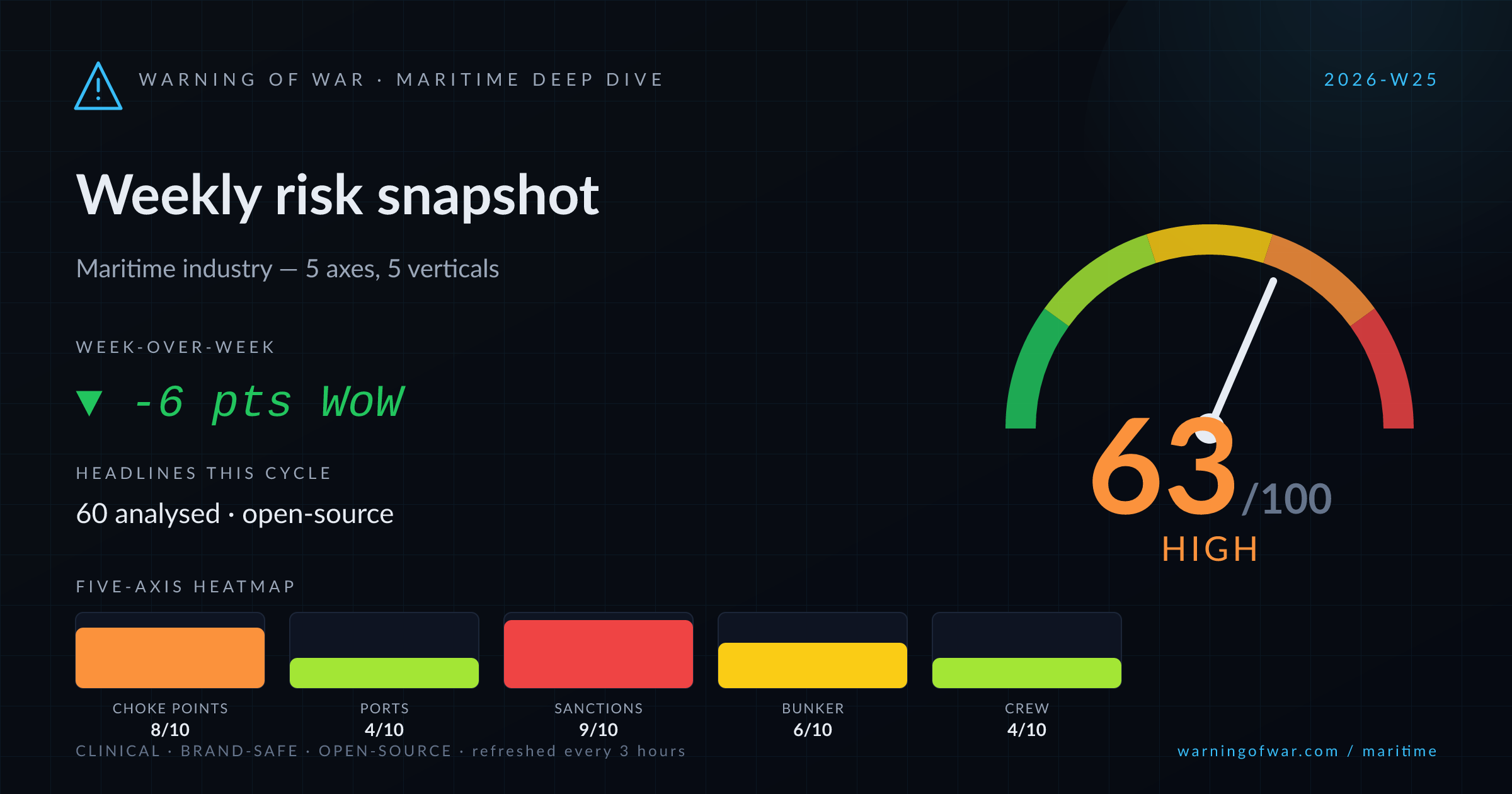
63/100 · High — -6 pts WoW.
The Strait of Hormuz dominates this cycle: a US-Iran preliminary agreement has initiated a phased reopening, with Iranian vessels now transiting, but Mitsui OSK Lines and other major tanker operators warn that full commercial normalization will require weeks. War-risk premium persistence is confirmed by London's insurance market. Concurrently, the UK has enacted its most expansive Russia sanctions package to date, designating 70 vessels in the shadow fleet — including LNG tankers, a G7 first — and targeting Yandex Bank. The EU has moved in parallel with an interim shadow-fleet package. Container freight rates are surging ahead of seasonal norms. Suez Canal oil tanker traffic rose 28% during the Hormuz disruption.
| Axis | Score | Band | WoW |
|---|---|---|---|
| Choke Point Stress | 8/10 | High | ▼ -1 |
| Port Congestion | 4/10 | Guarded | ▼ -1 |
| Sanctions & Compliance | 9/10 | Critical | ▲ +1 |
| Bunker Volatility | 6/10 | Elevated | ▼ -1 |
| Crew & Labour | 4/10 | Guarded | ▼ -1 |
→ no change
VLCC and crude tanker rates experienced significant volatility during the Hormuz closure, with the world's largest tanker operator (Mitsui OSK Lines) publicly warning that comfortable transit will take weeks to resume. War-risk premiums remain elevated in London markets. Suez Canal oil tanker traffic rose 28% as vessels rerouted. Shadow-fleet LNG tankers face new UK and EU designation, constraining available tonnage for Russian cargo and pressuring compliant owners' competitive positioning.
Operational signals
Headlines this cycle
→ no change
Dry-bulk operators with Gulf-origin or Gulf-destination voyages face residual route uncertainty as Hormuz normalizes over weeks rather than days. Persian Gulf fertilizer and grain export flows that were constrained during the closure are positioned to resume, but shipowners remain cautious pending clearer transit safety signals. Shadow-fleet sanctions carry limited direct exposure for mainstream dry-bulk operators, though flag-state compliance reviews may tighten.
Operational signals
Headlines this cycle
→ no change
Container freight rates are accelerating earlier than seasonal norms, driven by front-loading demand ahead of Hormuz uncertainty and broader supply-chain risk repositioning. Schedule reliability on Asia–Europe and Asia–Middle East lanes remains under pressure while Hormuz transit confidence rebuilds. Carriers are managing blank sailings and capacity allocation carefully, with the rate surge creating short-term revenue upside but complicating shipper contract negotiations.
Operational signals
Headlines this cycle
▼ -1 WoW
Bourbon has secured a multi-month subsea services contract on Ghana's Jubilee field, deploying the MPSV Bourbon Evolution 802 — a positive demand signal for OSV operators in West Africa. AD Ports Group and Dajin Heavy Industry signed an MoU on offshore wind supply-chain and port infrastructure cooperation. The Dutch government has lifted tender price ceilings for two 1 GW offshore wind sites, signalling improved project economics. A UK developer has requested a timeline extension for a 1.5 GW offshore wind project, introducing scheduling uncertainty.
Operational signals
Headlines this cycle
▼ -2 WoW
No material direct commercial disruption signals for the yacht and leisure segment appear in this cycle's headlines. Residual war-risk conditions in the Persian Gulf and Hormuz corridor represent a routing constraint for superyachts and private vessels transiting between the Mediterranean and Indian Ocean. London insurance market's persistent war-risk premium applies to leisure-class hulls as well as commercial vessels operating in the region.
Operational signals
Headlines this cycle
No named disruption events reported in this cycle.
Outlook pending next cycle.