Critical Minerals & Rare Earths
7/10High
China export-control risk escalates as India-US critical minerals pact formalises alternative supply architecture.
WEEKLY REPORT · 2026-W22 · May 25 – May 31, 2026
Weekly commodities & raw materials risk snapshot — composite 62/100 (High), ◆ first weekly snapshot.
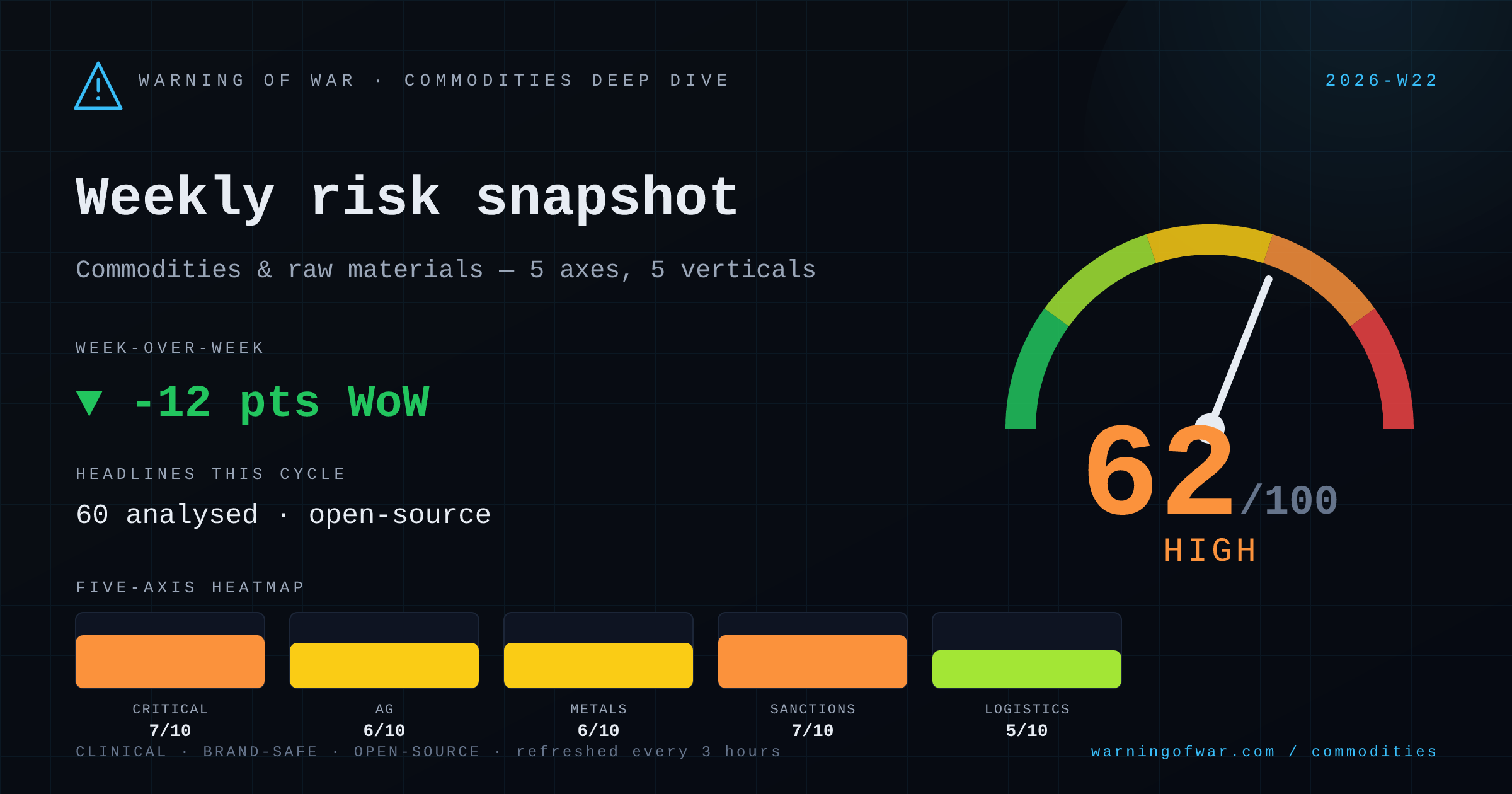
This cycle's dominant commercial signal is the Iran geopolitical disruption, compressing Middle East fertilizer flows and triggering a Chinese urea export relaxation to partially offset global supply shortfalls. Copper benchmarks on the LME and SHFE pulled back on hawkish central-bank posture before recovering partially on US-Iran ceasefire signals. China's steel sector registered output at a multi-year low while iron ore imports from Brazil's Tubarão and Australian Pilbara ports held firm, signalling a structural inventory-build dynamic. The India-US Critical Minerals Framework adds formal diversification architecture to reduce dependence on Chinese REE and gallium export controls. SQM's Atacama operations logged a surge in quarterly profit as lithium market tightening advances.
Each axis scored 1–10 from open-source signals. The composite at the top is a weighted blend.
High
China export-control risk escalates as India-US critical minerals pact formalises alternative supply architecture.
Elevated
Rice demand compression in Japan and structural saline-land yield gains in Vietnam provide mixed grain-market signals.
Elevated
Brazil's coffee harvest opens under weather-risk watch, with StoneX flagging harvest-window conditions as price-sensitive.
High
Copper pulled back on hawkish central-bank posture and Iran-linked risk-off, while Chinese steel hits a multi-year output low despite sustained iron ore import demand.
Critical
Iran war disrupts Middle East fertilizer flows; China lifts fresh urea export quota while European and North American importers face acute margin pressure.
No named disruption events reported in this cycle.
Outlook pending.
← All weekly reports · Methodology →
Important: Warning of War provides AI-generated risk intelligence from public open-source data. Output is informational only — not investment advice, official assessment, or operational guidance. Always consult primary sources and qualified analysts before any commercial decision.