Upstream Oil & Gas
7/10High
Hormuz reopening unwinds geopolitical premium, but OECD stock depletion and supply recovery lags keep the upstream outlook cautious through mid-2027.
WEEKLY REPORT · 2026-W25 · Jun 15 – Jun 21, 2026
Weekly energy markets risk snapshot — composite 60/100 (High), ◆ first weekly snapshot.
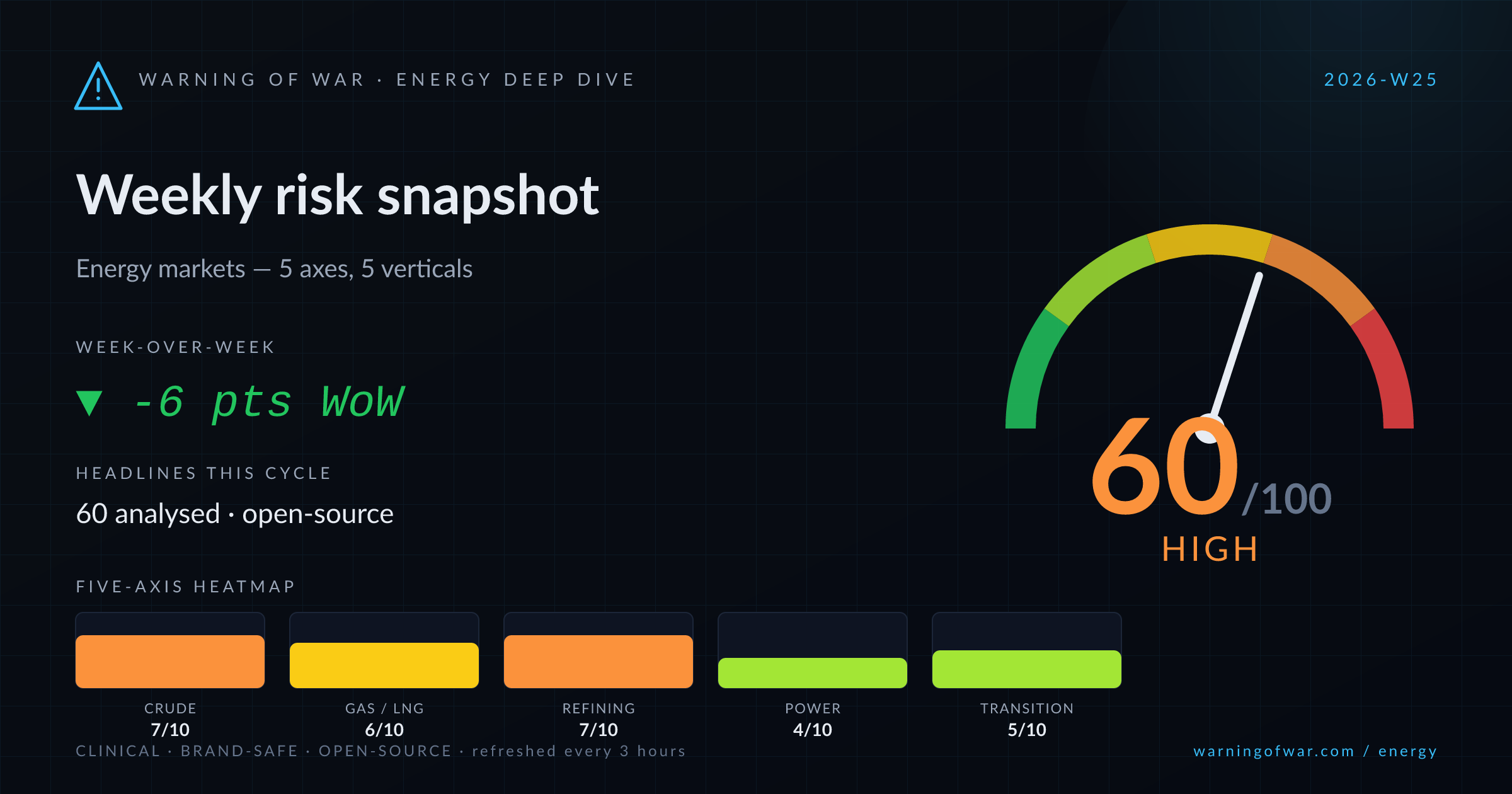
A tentative U.S.-Iran peace agreement has triggered a rapid unwind of the Hormuz risk premium, with Brent falling below $80/bbl and WTI targeting the $73 range. Iranian crude exports have resumed, Murban and Dubai spot premiums have collapsed, and the IEA projects a significant 2027 oil surplus as Gulf supply recovers. However, shipping firms remain reluctant to transit Hormuz at full capacity, OECD oil reserves sit at 1990 lows, and a major Saudi refinery — cited by TotalEnergies CEO Patrick Pouyanné — will not return to full output until early 2027. The Ichthys LNG strike in Australia has resolved, easing short-term JKM pressure, while Qatar is repositioning tankers for Hormuz restart. ECB officials caution that Europe's energy price shock will persist for months despite the deal.
Each axis scored 1–10 from open-source signals. The composite at the top is a weighted blend.
High
Hormuz reopening unwinds geopolitical premium, but OECD stock depletion and supply recovery lags keep the upstream outlook cautious through mid-2027.
High
Ichthys LNG strike resolution and Qatar's Hormuz repositioning provide near-term supply relief, while South Africa's new import terminal and Canadian FLNG projects signal structural demand growth.
High
A major Saudi refinery will not reach full capacity until early 2027 per TotalEnergies, keeping global refined product supply constrained even as crude oil risk premiums deflate.
Elevated
California gas-fired generation falls 60% year-on-year as solar and imports surge, illustrating accelerating fuel-switching dynamics in major Western power markets.
Elevated
India's 157 GW solar milestone and OMV Petrom's Bulgaria solar-plus-storage FID signal sustained build-out momentum, offset by cancellation risk on Paraguay green hydrogen and policy uncertainty.
A tentative U.S.-Iran peace agreement has nominally reopened the Strait of Hormuz to crude and LNG transit, but shipping industry operators cite full-capacity resumption as unlikely before 2026, sustaining freight rate and route-risk premiums in the near term.
A major Saudi Arabian refinery sustaining damage during the Iran conflict will not return to full operational capacity until early 2027, per TotalEnergies CEO Patrick Pouyanné, maintaining a structural gap in global refined product supply independent of crude oil price recovery.
OECD commercial oil reserves have fallen to their lowest level since 1990 following the Hormuz crisis-driven supply disruption, removing the strategic buffer that historically moderates acute supply shocks.
A weeks-long industrial dispute at the Inpex-operated Ichthys LNG facility in Australia has been resolved via a pay agreement with Offshore Alliance, AWU, and ETU unions, restoring full LNG export capacity from the facility and relieving near-term JKM spot market tightness.
QatarEnergy has begun repositioning LNG tankers toward the Middle East in anticipation of Hormuz reopening, signalling an imminent resumption of full Qatari LNG export volumes into Asian and European spot markets.
Iran's first observed crude oil exports in approximately two months have transited past the former U.S. naval blockade point, with the Iranian tanker fleet simultaneously gearing up to accelerate volumes ahead of formal deal signing, materially adding to Atlantic and Asian crude supply balances.
Over the 60–90 day forward window, the dominant commercial variable is the pace and credibility of Hormuz normalisation. Shipping industry reluctance to return to full Hormuz transit capacity — with the lobbying group citing 2026 for full volume recovery — will sustain elevated freight rates and product-supply tightness even as crude oil spot prices deflate toward the $73–80/bbl range. The Saudi refinery outage (TotalEnergies-confirmed, operational by early 2027 at the earliest) will keep diesel and jet crack spreads structurally supported through the remainder of 2025 and into H1 2026. The IEA's 2027 oil surplus projection — anchored on UAE output exceeding 5 million bpd and broader Gulf supply restoration — will continue to suppress medium-term futures curves and investor appetite for high-cost upstream projects. On gas and LNG, Ichthys restart and Qatar's tanker repositioning should progressively relieve JKM and TTF spot tightness, though the ECB's concurrent interest-rate hike in response to the European energy price shock adds cost-of-capital pressure to utility and infrastructure balance sheets. OECD reserve levels at 1990 lows create a re-stocking demand impulse that may provide a price floor, limiting the downside for Brent in the near term. Poland's windfall tax precedent may prompt similar legislative action in other European jurisdictions, introducing margin risk for refining-integrated energy majors operating in the EU.
← All weekly reports · Methodology →
Important: Warning of War provides AI-generated risk intelligence from public open-source data. Output is informational only — not investment advice, official assessment, or operational guidance. Always consult primary sources and qualified analysts before any commercial decision.