Warning of War
LIVE --:-- UTC

WEEKLY REPORT · 2026-W25 · Jun 15 – Jun 21, 2026

Macro Deep Dive

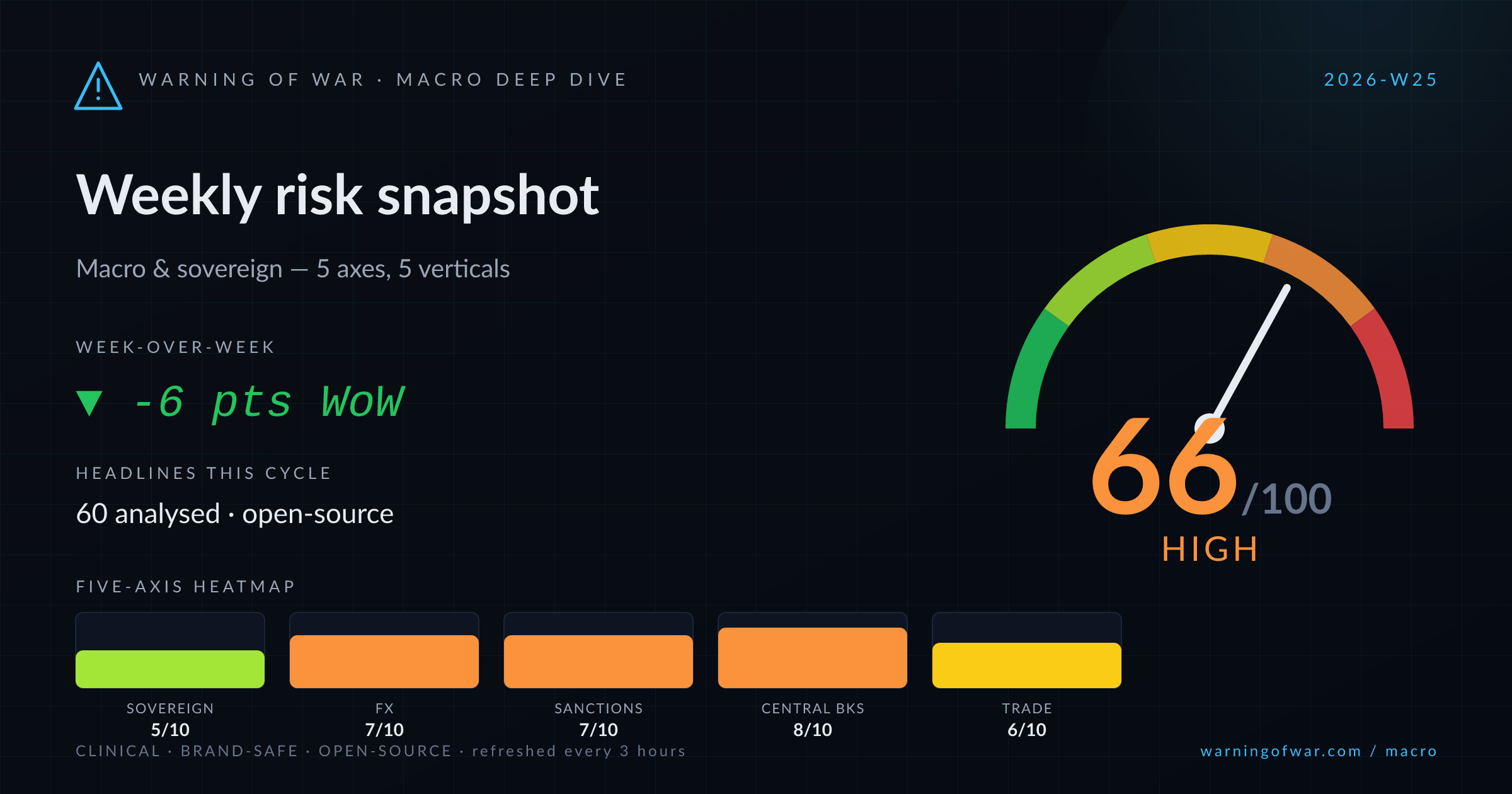
Weekly macroeconomic & sovereign risk snapshot — composite 66/100 (High), ◆ first weekly snapshot.

Generated 10:56 UTC · 60 headlines analysed

Macro Deep Dive scorecard for 2026-W25

Executive brief

Global macro conditions are shaped this cycle by three dominant forces: the Kevin Warsh-led Federal Reserve signalling a hawkish rate-hike trajectory, injecting significant uncertainty into G10 and EM rate expectations; a US–Iran diplomatic agreement altering Strait of Hormuz supply-route calculus and affecting oil-linked sovereign fiscal positions; and an active multi-jurisdictional sanctions environment featuring the UK's 21st Russia package, OFAC enforcement against Cuba-linked JVs, and Bulgarian resistance to EU restrictive measures. Fitch's sovereign upgrade of South Africa — with a pass-through to Eskom — and the IMF's fifth Jordan programme review provide counterbalancing positive sovereign signals. PBOC bond-market expansion and Bank of Korea FX repatriation guidance add EM monetary complexity.

Five-axis breakdown

Each axis scored 1–10 from open-source signals. The composite at the top is a weighted blend.

  • Sovereign Credit & Default 5/10
  • FX & Currency 7/10
  • Sanctions & Capital Flows 7/10
  • Central Bank Policy 8/10
  • Trade & Balance of Payments 6/10

Industry verticals

Sovereign Credit & Debt

5/10

Elevated

Mixed sovereign signals: Fitch upgrades South Africa and Eskom, Gabon re-enters Eurobond markets, while Jordan advances IMF programme milestones and Iraq's commodity-revenue concentration draws World Bank attention.

FX & Currency Markets

7/10

High

USD strength driven by Warsh Fed rate-hike signalling is pressuring EM currencies — most visibly the Korean won — while the SNB signals readiness for CHF intervention and the Nigerian naira remains under surveillance.

Sanctions & Capital Flows

7/10

High

The UK tightens Russia-network sanctions with a Nigeria-linked entity designation; OFAC enforcement freezes a Cuba-linked Australian mining JV; the US Russia-oil sanctions waiver expiry creates supply-chain exposure; and Bulgaria's resistance to EU Sanctions Package 21 introduces an intra-EU compliance fracture.

Central Banks & Policy

8/10

Critical

Kevin Warsh's debut as Fed Chair signals a materially hawkish policy recalibration — including restructured working groups and a firm 2% inflation anchor — while the Philippine central bank hikes rates, the PBOC expands bond-market tools, and the SNB retains FX intervention optionality.

Trade Policy & Tariffs

6/10

High

The US–Iran diplomatic agreement and Strait of Hormuz reopening prospects trigger oil price declines with significant trade-balance implications for oil-exporting sovereigns; China's competitive pressure on European automakers intensifies; and the G7 agenda addresses multilateral trade cohesion.

Disruption events

  • Warsh Fed Hawkish Recalibration ACTIVE

    Incoming Federal Reserve Chairman Kevin Warsh's debut signals a structurally hawkish monetary policy shift — withholding dot-plot guidance and restructuring internal working groups — materially raising rate-hike expectations and EM capital-flow volatility.

    Vertical: central-banks-policy
  • US–Iran Diplomatic Agreement ACTIVE

    A US–Iran diplomatic agreement has been signed, triggering a Strait of Hormuz supply-route normalisation outlook, driving oil-price declines and creating potential future sanctions-relief variables for Iranian sovereign and energy-sector assets.

    Vertical: sanctions-capital-flows
  • EU Russia Sanctions Package 21 — Bulgarian Resistance ACTIVE

    Bulgaria's sustained opposition to specific provisions of the EU's 21st Russia sanctions package — notably over Patriarch Kirill-related designations — is creating intra-EU enforcement cohesion risk and delaying the package's full implementation perimeter.

    Vertical: sanctions-capital-flows
  • UK Russia-Network Sanctions Expansion RISING

    The UK has expanded its Russia-network sanctions enforcement with the designation of a Nigeria-linked entity, extending cross-jurisdictional compliance exposure for African-corridor financial institutions and correspondent banks.

    Vertical: sanctions-capital-flows
  • Korean Won Depreciation Pressure ACTIVE

    The Korean won is under material depreciation pressure driven by Fed rate-hike expectations and structural outbound equity investment flows, with the Bank of Korea formally urging capital repatriation as a stabilisation mechanism.

    Vertical: fx-currency
  • Fitch South Africa Sovereign Upgrade STABLE

    Fitch Ratings has upgraded South Africa's sovereign credit rating, with a direct positive pass-through to Eskom's credit profile, marking an improvement in the country's fiscal credibility trajectory under the current administration.

    Vertical: sovereign-credit

Forward outlook (60–90 days)

Over the 60–90 day forward window, the dominant macro pressure vector is the Federal Reserve's policy-path uncertainty under Chairman Warsh: markets should anticipate continued USD strength, elevated US Treasury yield volatility, and sustained EM capital-flow headwinds — particularly for KRW, NGN, and other current-account-deficit currencies. The US–Iran agreement, if it progresses toward sanctions relief and full Strait of Hormuz normalisation, will suppress oil prices further, compressing fiscal revenues for commodity-dependent sovereigns including Iraq, Nigeria, and Gabon — partially offsetting Gabon's positive Eurobond re-entry signal. The EU's 21st Russia sanctions package remains at risk of delayed or partial implementation pending Bulgarian consensus resolution; compliance desks should monitor the intra-EU negotiation timeline closely. OFAC enforcement activity — as evidenced by the Cuba JV freeze and Russian-oil waiver expiry — suggests a sustained extraterritorial enforcement posture. The PBOC's bond-market pivot and Philippine BSP rate hike signal divergent EM monetary conditions that will affect regional fixed-income allocations. Sovereign-credit analysts should monitor Nigeria's IMF engagement trajectory, Sri Lanka's IMF programme milestone delivery, and the World Bank's Iraq fiscal-diversification assessments as leading indicators of EM sovereign stress or resilience.

← All weekly reports · Methodology →

Important: Warning of War provides AI-generated risk intelligence from public open-source data. Output is informational only — not investment advice, official assessment, or operational guidance. Always consult primary sources and qualified analysts before any commercial decision.