Tanker Markets
9/10Critical
Hormuz blockade traps large crude tankers, driving war-risk premiums and route disruption to systemic levels for the segment.
WEEKLY REPORT · 2026-W23 · Jun 1 – Jun 7, 2026
Weekly maritime industry risk snapshot — composite 67/100 (High), ◆ first weekly snapshot.
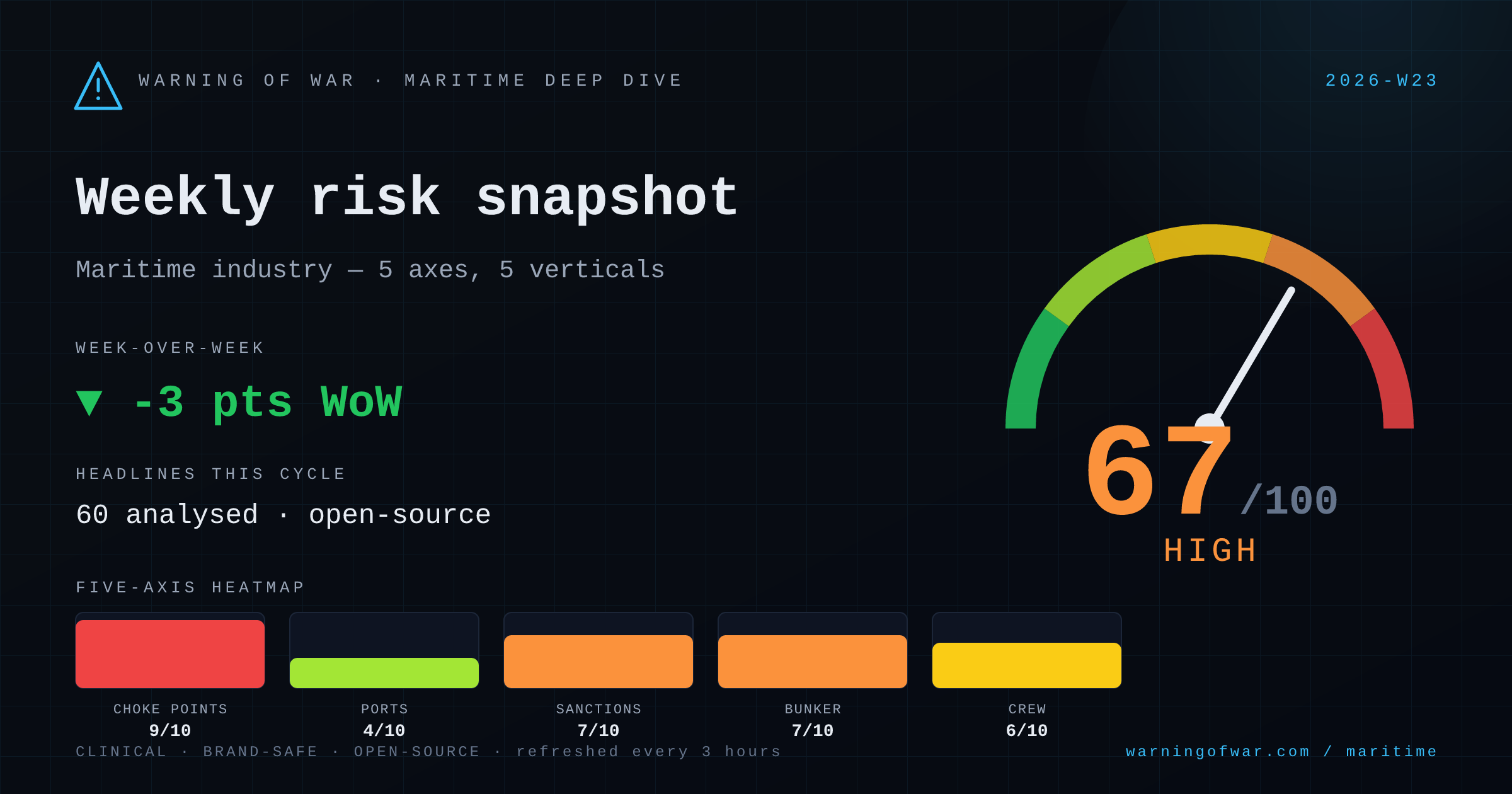
The Strait of Hormuz remains the dominant commercial risk signal this cycle, with the waterway operating under active blockade conditions and transit access contingent on evolving U.S.-Iran diplomatic negotiations. War-risk insurance premiums on Persian Gulf routes are elevated; vessel rerouting costs are compounding freight-rate pressure across tanker and container segments. Shadow-fleet enforcement activity in the Atlantic adds sanctions-compliance friction. Bab-el-Mandeb re-escalation risk is flagged in open-source commentary. Container schedule reliability improved marginally to 62.4% in April 2026. Crew-change restrictions in the Gulf persist per IMO guidance. Bunker costs are rising on oil-price pressure and alternative-fuel transition activity.
Each axis scored 1–10 from open-source signals. The composite at the top is a weighted blend.
Critical
Hormuz blockade traps large crude tankers, driving war-risk premiums and route disruption to systemic levels for the segment.
Elevated
Capesize rate softening weighs on the Baltic Dry Index while Indian iron ore demand growth provides a partial demand-side counterweight.
High
Container schedule reliability edges up to 62.4% in April but MSC boxship damage off Iraq and Hormuz-driven rerouting sustain elevated freight-cost and schedule-reliability risk.
High
FPSO contracting advances in Brazil while offshore wind award activity in Japan and Ireland signals sustained project pipeline demand for OSVs and specialist vessels.
Elevated
Cruise LNG bunkering expands in Latin America while no material superyacht or marina disruption signals are present this cycle.
No named disruption events reported in this cycle.
Outlook pending.
← All weekly reports · Methodology →
Important: Warning of War provides AI-generated risk intelligence from public open-source data. Output is informational only — not investment advice, official assessment, or operational guidance. Always consult primary sources and qualified analysts before any commercial decision.